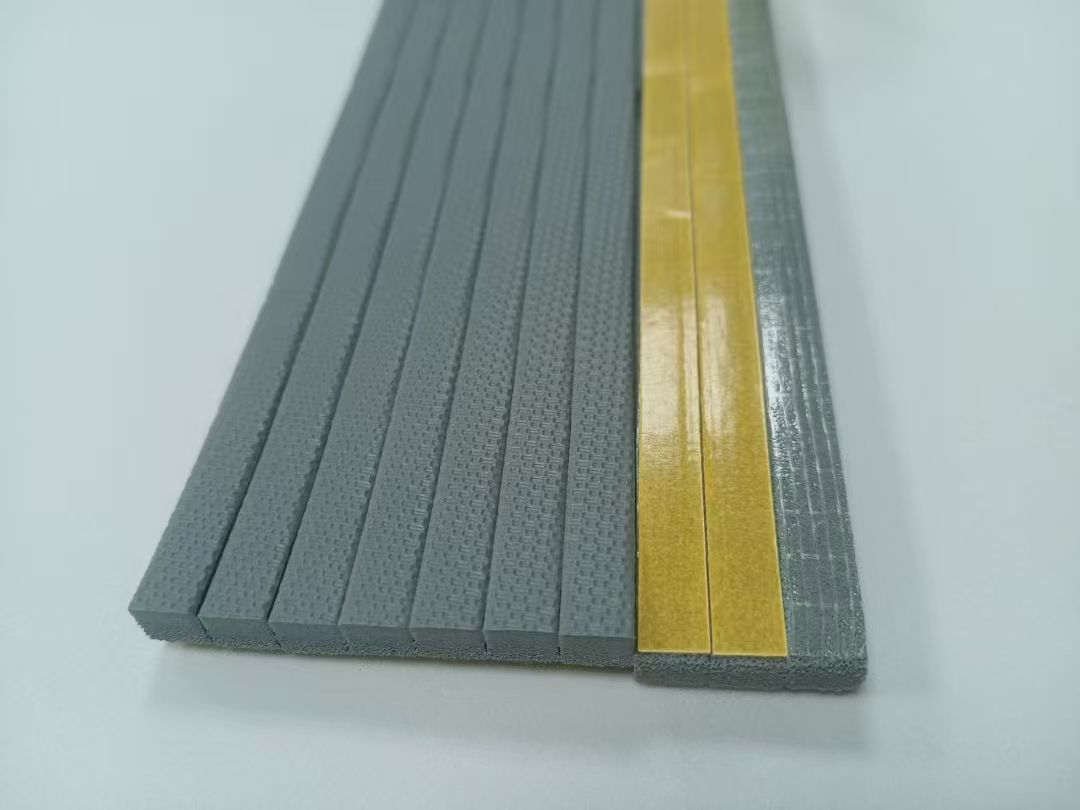
Creasing Matrix: The Critical Consumable in Die-Cutting and Creasing
1. The problem the creasing matrix solves
Cutting rules and creasing rules in a die are not the same height. A cutting rule must penetrate through the material, whereas a creasing rule must only compress a fold line without severing the board. The height difference between the two must be compensated on the counter side. The creasing matrix performs exactly this function: its thickness builds up the counter surface so that the creasing rule reaches the correct penetration depth, forming a foldable channel while the cutting rules bottom out cleanly on the plate.
This apparently simple compensation has two direct consequences. It determines whether the crease runs straight and stays in register, and it governs whether the outer layers of the board remain intact when folded. With heavier board grades and corrugated substrates, a channel that is too narrow or too shallow will cause spring-back or fibre fracture, while an oversized channel produces a soft, poorly defined fold.
2. Construction and working method
A typical creasing matrix consists of several functional layers. A strong adhesive backing anchors the matrix to the counterplate and resists movement during sustained production. The central matrix body forms the creasing channel; its thickness sets the crease depth, and its channel width defines the space available for the folded material. A locating strip on top grips the creasing rule during installation for rapid alignment and is removed once the matrix is in place.
The working sequence is straightforward: measure the creasing rule, cut the matrix to length, locate it on the counterplate directly beneath the rule using the locator strip, remove the strip, and make a test impression. Compared with hand-cut counter formes, self-locating creasing matrix reduces counter preparation from tens of minutes to roughly ten minutes and substantially lowers dependence on individual operator skill.
3. Material types and application fit
The backing material of a creasing matrix is the primary determinant of its durability and application range. Three families dominate.
PVC-based matrices use a high-density PVC backing. They are flexible, economical, and gentle on paper surfaces, with a typical service life on the order of 50,000 impressions. They are the mainstream choice for short-to-medium runs of standard folding cartons and corrugated litho-laminated boxes, and represent the most widely used category of self-adhesive creasing matrix.
Fibre-based (resin) matrices employ a high-density fibre backing with markedly higher hardness and wear resistance, achieving service lives of 120,000 impressions or more. They are specified for cigarette cartons, pharmaceutical folding boxes, and cosmetic cartons where crease precision and consistency across long runs are critical.
Paper-based matrices use a high-density paper backing that combines flexibility with heat resistance and low abrasion, with service lives exceeding 100,000 impressions. They are applied in longer runs of premium folding box board and corrugated cartons.
At the high-performance end, film-based and metal-based matrices extend the boundaries further. Film-based products use a flexible upper layer with an extremely sharp outer edge to improve sheet transfer and production reliability, and are suited to large-format packaging and displays. Metal-based matrices address reduced crease-rule-height tooling where dimensional stability is paramount.
4. Selection: depth and channel width
Matrix selection revolves around two parameters: thickness (channel depth) and channel width.
In thickness terms, the governing principle is that the matrix thickness equals the height difference between the cutting rule and the creasing rule, and that difference is set by the caliper of the material being processed. For folding box board, the matrix depth generally corresponds to the board thickness. For corrugated board, the compressed caliper of the flute structure is the correct basis.
Channel width must account for both the board thickness and the width of the creasing rule. A widely used calculation is:
Channel width for carton board = board thickness × 1.5 + creasing rule thickness
Channel width for corrugated board = compressed board thickness × 2.0 + creasing rule thickness
The logic behind the formula is that the channel must provide enough room for the folded material to accommodate the bend without over-compressing the fibres, while still guiding the creasing rule into a precise seat. An undersized channel concentrates stress at the fold line and raises the risk of score cracking. An oversized channel produces a loose crease that fails to hold a crisp folded edge.
5. Applications and industrial significance
Creasing matrices serve virtually every folding application in paper-based packaging: folding cartons, corrugated cases, cigarette and liquor cartons, pharmaceutical and cosmetic boxes, gift boxes, and premium rigid-box wraps all depend on a matched matrix–rule combination to deliver a consistent crease. On high-speed folder-glugers, crease straightness and depth uniformity directly affect blank feeding and final squareness. In luxury and cigarette packaging, matrix selection can determine whether a visible crack or whitening appears along the fold.
From a manufacturing standpoint, the creasing matrix has transformed counter preparation from a hand-carved craft into a standardised, repeatable consumable assembly. It lowers the skill barrier, shortens make-ready, and gives complex packaging structures a more reliable route to production. In this quiet auxiliary material lies a measurable bridge between packaging precision and production efficiency.
Ejection Rubber: A Complete Guide to Types, Applications and Selection Tips